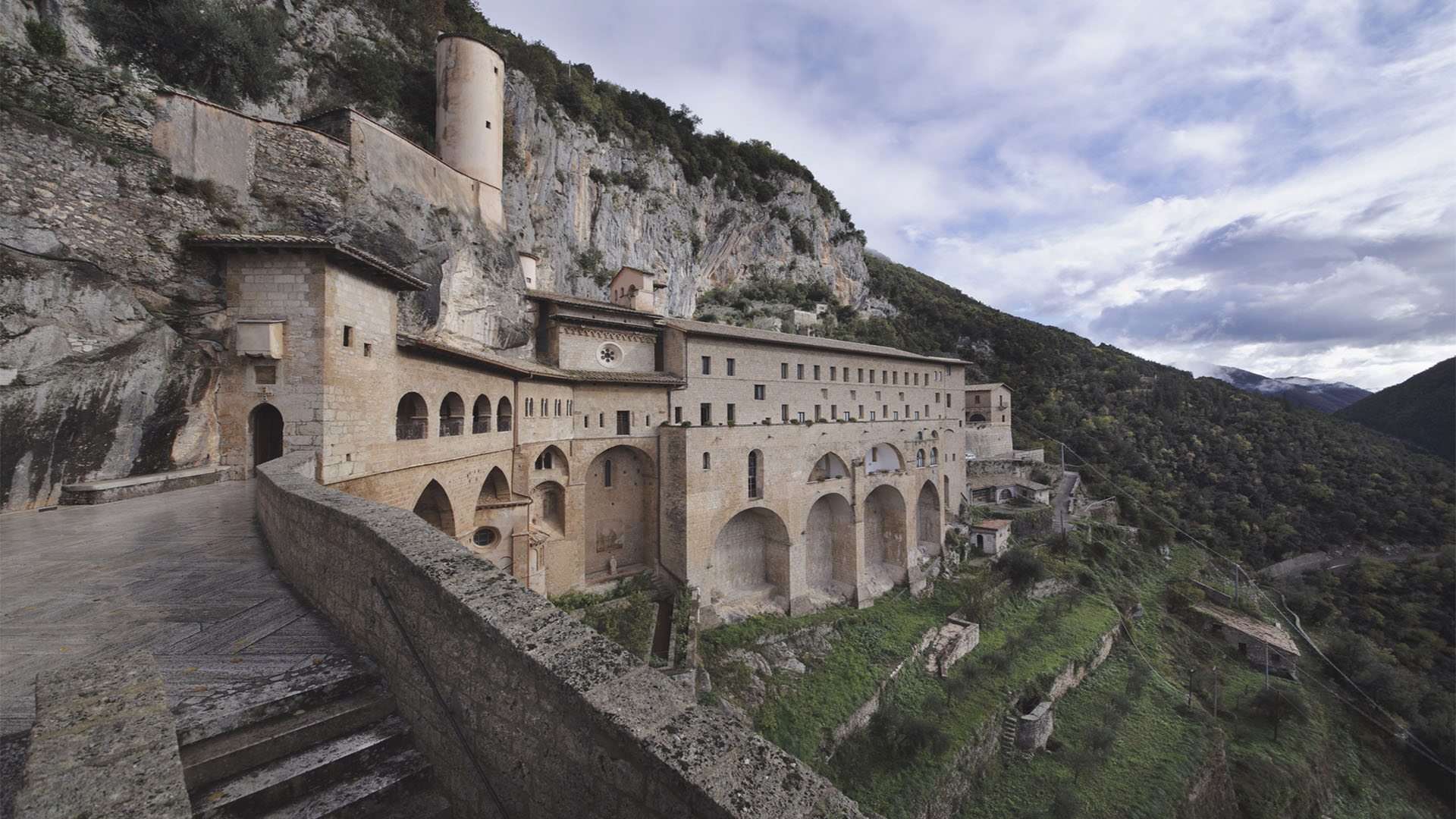
The village is gathered around the Rocca dei Borgia. Arriving in Subiaco you are welcomed by the Medieval Bridge of San Francesco, built in 1358, which crosses the river Aniene and leads to the convent of the same name dedicated to the Saint of Assisi.
At the entrance to the city there is also the Triumphal Arch erected by Pope Pius VI.
The village is entirely clustered around the Rocca dei Borgia.
Another characteristic glimpse of Subiaco is the Medieval Village of Opificio located on the left bank of the river and which is the oldest district of the city.
The area became a holiday destination very popular with the Romans as evidenced by the remains of the Imperial Villa built by Nero. Right on the ruins of this villa in the 5th century AD San Benedetto da Norcia built one of the twelve monasteries in the area, all later destroyed by the Saracens, except for that of Santa Scolastica.
The history of Subiaco is also linked to that of the press: it was in the monastery premises that in 1465 two German printers gave life to the first Italian typography.
Built between 1073 and 1077 by the abbot of S. Scolastica, Giovanni V, who transformed it into a feudal castle with a mighty tower and prisons, it was enriched with rooms and apartments and a small church dedicated to St. Thomas the Apostle. It thus became the symbol of the abbey’s power and the habitual residence of Giovanni and his successors, until the earthquake of 1349 and the rebellion of the people under the regime of Abbot Angelo Monreale, who forced his successor, the Frenchman Ademaro, to retreat to Jenne.
This is a reconstruction of a primitive building. It was originally a chapel, built to commemorate the miracle of the prompt obedience of Mauro, a faithful disciple of St. Benedict, who had sent him to save Placido, who was drowning in the lake while drawing water. Mauro’s obedience was so immediate that he did not notice he was walking on the waters of the lake without drowning, as St. Gregory the Great recounts in the second book of his Dialogues.
In Contrada S. Angelo, on the left side of the Sublacense state road, coming from Subiaco, there is a round arch, made of stone and brick, blackened by time, built by Count Pietro Lucidi in 1854 at the entrance to his rural estate, on a small sarcophagus made of local stone, framed by a sepulchral monument, discovered in 1843, belonging to the Republican era of ancient Rome.
Cylindrical in shape, with loopholes and rectangular battlements, slender and majestic, surrounded by lush vegetation and supported by an elegant cornice. It overlooks the entrance to a driveway leading to a villa. In reality, the name is not used because, in light of historical documents, it does not appear that the local Carbonari met in the villa, of which the tower was supposed to be the symbol.
Described by Frontinus, it was built in the 1st century AD by the emperors Caligula and Claudius. Since Rome’s water was murky, Trajan had to extend it another 10 km to the highest lake in Nero’s villa, where the water was very clear. Later restored by other emperors, during the Gothic War, during the siege of Rome, it was cut off by Vitiges along with other aqueducts to prevent the flow of drinking water into the city. At the time of St. Benedict, it was fully operational.
Nero (58-64 AD) built the Villa Sublacense in the narrow gorge of the Aniene River between Mount Taleo and Mount Francollano in the Simbruini Mountains. The construction predates 60 AD, as a singular episode occurred before that year: the historian Tacitus (Annales 14.22) recounts that, while the emperor was feasting, lightning struck the food and broke the table.