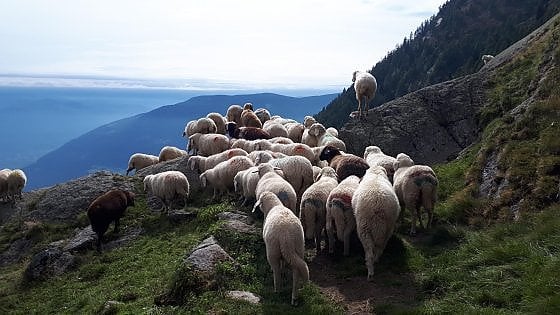
Among the traditions that have marked the history of the people and lands of Abruzzo, transhumance is certainly one of the oldest and most representative. There are various types, including vertical transhumance or alpine grazing, which involves moving livestock to high-altitude pastures in spring and back down to the plains in autumn, and transhumance proper, which involves moving livestock over long distances to pastures located in a different region.
Over the centuries, networks of paths dedicated exclusively to transhumance have developed, such as the characteristic “tratturi,” long paths connecting the vast mountainous territories of Abruzzo to the pastures of Puglia, left free of crops to avoid damage to the passage of herds. The largest is the “Tratturo Magno,” 244 km long, which descends from the mountains of Abruzzo through valleys, villages, and small towns, until it reaches the plains of Foggia, in the Tavoliere delle Puglie.
Transhumant shepherds traveled these ancient routes on foot, each with his own flock, and in the evening they ate baked bread and ricotta cheese with plenty of wine to warm their hearts and spirits far from home. The millennial practice of transhumant sheep farming has shaped the landscape and the structure of mountain ecosystems. The sparse pastures, rich in orchids, are now a habitat protected by the European Union, whose conservation depends largely on the continuation of sustainable pastoralism. To this end, the Abruzzo National Park has launched several initiatives to support local farmers and breeders in the recovery of ancient cultivated varieties and wool processing.