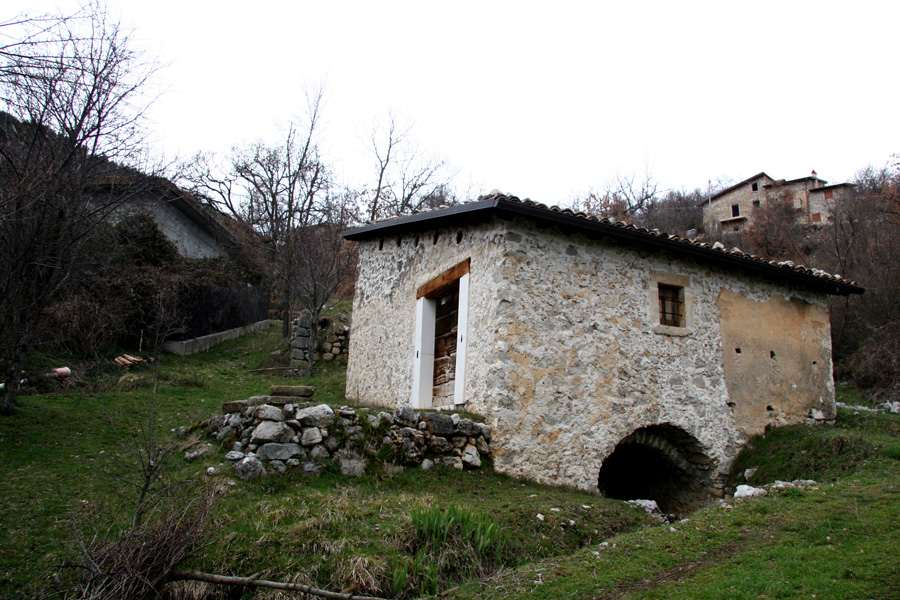
The Monte Frontino tunnel, a hill rising opposite the hamlet of Corvaro (Municipality of Borgorose in the province of Rieti), is one of the oldest hydrogeological sites in the Cicolano area.
This tunnel is located at 960 metres above sea level and its entrances cross the entire mountain.
From the 18th century until the mid-20th century, the tunnel was used as a cistern into which the waters of the Apa stream were channelled, suitably dammed, in order to power the water mills located downstream, the first of which was known as “Mola Martorelli”.
The tunnel, dug into the living rock, was intended to open a channel to the various water sources of that mountain, for the irrigation of the adjacent fields, for the use of its thermal baths and to activate other hydraulic machines.
The tunnel has an ogival cross-section and a height varying from 1.60 metres to 4.60 metres, while its width ranges from 0.60 to 1.50 metres.
The thick muddy deposit and the presence of cast iron pipes make it extremely difficult to move inside it.
Along the route, there are several landslides that have caused the accumulation of debris and mud.
In 2010, the first speleological-archaeological investigations began inside the hydraulic structure.
At present, only a few hypotheses can be made about the dating of the tunnel.
As regards the excavation technique used, the Monte Frontino tunnel has numerous similarities with other examples in Lazio, in particular the excavation of the emissaries of Lake Nemi and Lake Albano or that of the Cannucceta aqueduct in Palestrina, which dates back to between the 6th and 5th centuries BC.
The conduit is completely excavated in the rock and has no wall covering or signs of plaster.
According to tradition, this hydraulic work has been attributed to the Romans around the 1st century AD, but there are no signs of renovation by them inside.