Italian nameBarbone di becco
Sinonimi Himantoglossum Hircinum: Satyrium hircinum L. – Orchis hircina(L.) Crantz –Loroglossum hircinum (L.) Rich. –Aceras hircinum (L.) Lindl.
Taxonomy
Kingdom: Plantae
Division: Magnoliophyta
Class: Liliopsida
Order: Orchidales
Family: Orchidaceae
Description Barbone di Becco
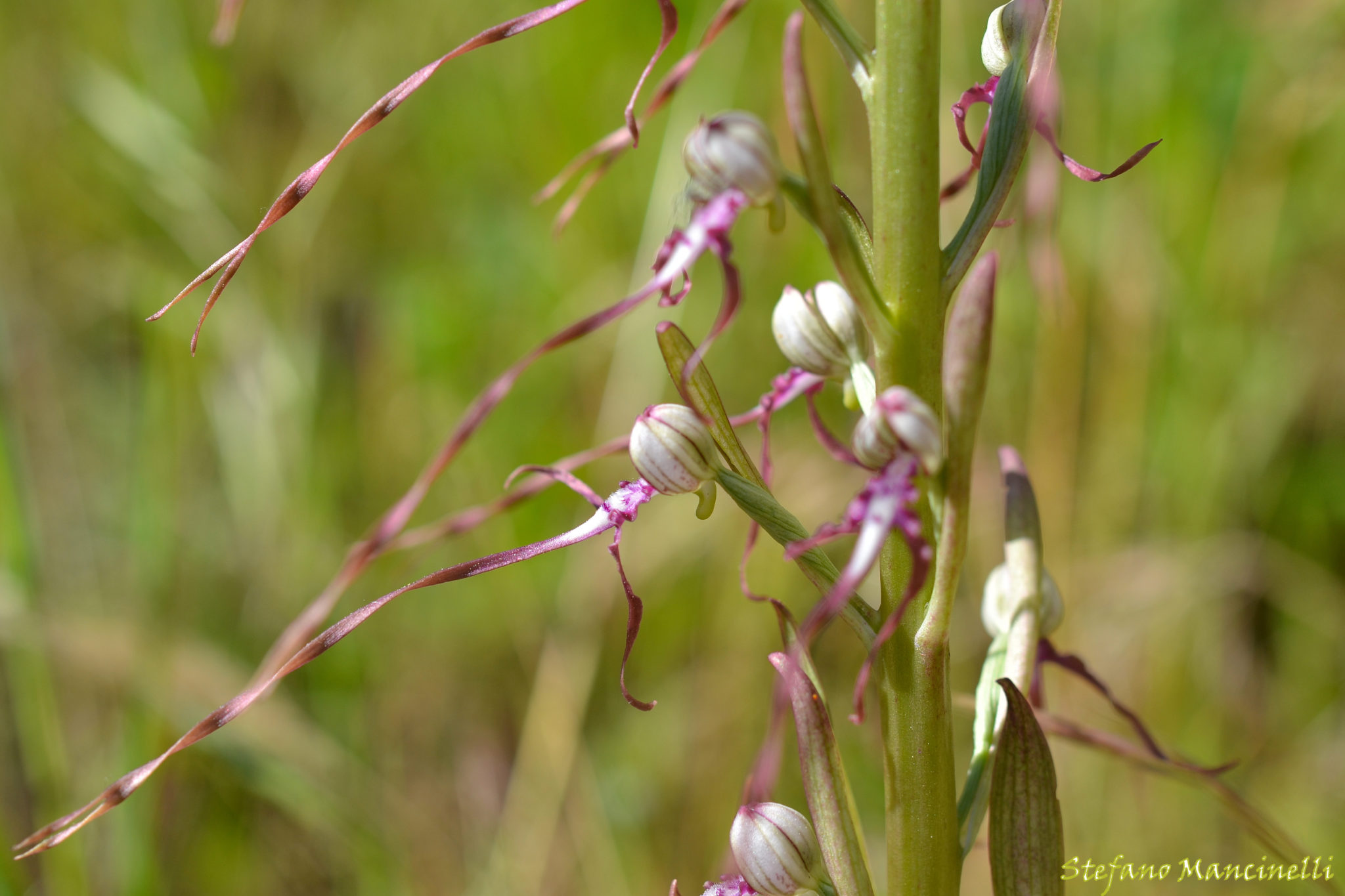
The name of the genus comes from the Greek terms himantos = strap, and glossa = tongue and, translated literally, means ‘strap-shaped tongue’, referring to the elongated shape of the labellum. The specific name comes from the Latin hircus = goat, referring to the characteristic smell of the flowers. The plant is 20 to 90 cm tall and has a sturdy stem, more or less tinged with a brownish-red colour. The large leaves are elliptical-lanceolate, the upper ones shorter and more pointed, sheathing the stem. The bracts are lanceolate, the lower ones longer than the flowers, the upper ones more or less equal to the flowers. The inflorescence is dense, composed of numerous (up to 80) flowers emitting an unpleasant goat-like odour. The petals and sepals are closely connected to form a greenish-white helmet, edged with purple on the outside and vertically striped with purple on the inside. The labellum is trilobed, with a ribbon-like, briefly bifid median lobe, repeatedly twisted, brownish-green in colour, with patches of purple-red hairs in the centre. Although the flowers produce little nectar, they are very fragrant and attract a large number of pollinators from various families: hymenoptera, diptera, coleoptera, etc. The variety Himantoglossum adriaticum, H. Baumann, is distinguished by its less robust appearance, looser inflorescence, almost odourless flowers, more briefly bifid median lobe and the colour of the latter, which can be, although not consistently, more white in colour.
Where to find the Barbone di Becco
This species is native to the Mediterranean Atlantic region and flowers between May and July. It is found in Tuscany, southern Italy, Sicily, Liguria, Piedmont and Emilia Romagna. Its preferred habitat is poor grasslands, scrubland and embankments on calcareous soil.