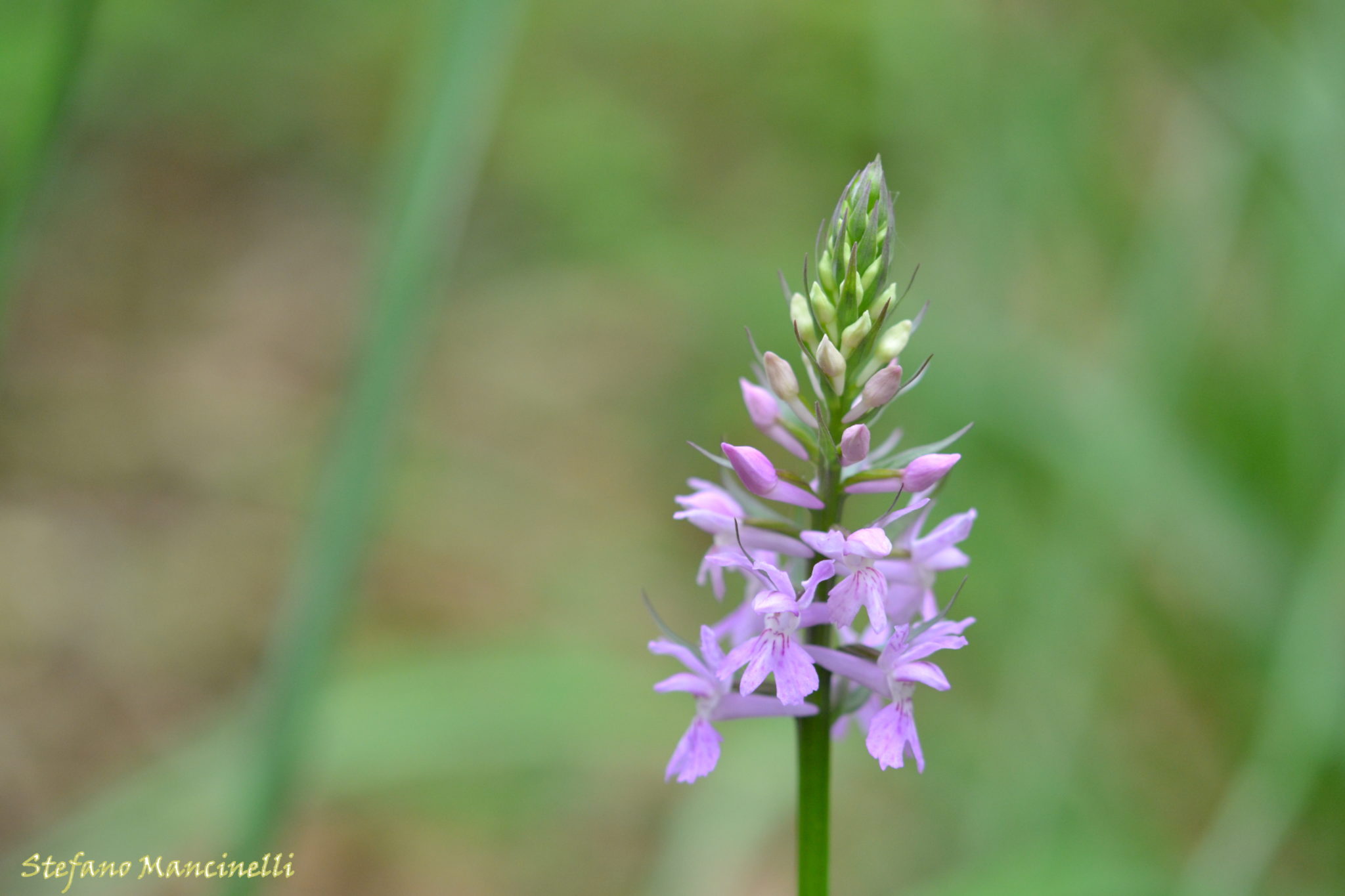
The spotted orchid (scientific name Dactylorhiza maculata (L.) Soó, 1962) is a herbaceous plant belonging to the Orchidaceae family.
The genus name Dactylorhiza derives from the Greek dactylos = finger and rhiza = root, referring to the shape of the tubercles, while the specific name maculata refers to the spotted leaves.
Italian name:Concordia
Synonyms Dactylorhiza maculata (L.) Soò, 1962: Orchis maculata – Orchis cornubiensis – Dactylorchis maculata
Description Concordia
This plant has palmate, deeply divided rhizomes and grows to a height of 30-70 cm, with a slender, flexible stem. The leaves are linear-lanceolate and arranged alternately; they are densely spotted on the upper side.
The inflorescence is more or less dense, elongated with numerous flowers (up to 50) of lilac colour and short bracts. The lateral sepals are divergent, while the median one is connivent with the petals; the labellum is deeply trilobed, broad, almost flat, decorated with purple or violet spots; the median dentiform lobe is well developed, while the spur of the labellum is stocky, conical and slightly curved downwards. Unable to produce nectar, Concordia attracts pollinating insects (pollinators) with visual deception: pollinators are attracted by the appearance of the flower, which resembles that of other nectar-producing species. The flowering period is from May to July.
Where to find Concordia
It is found in northern and central Italy. It is a wild plant in cool areas of Italy and tends to grow in deciduous woods or on slopes, preferably on calcareous soils.