

One of the books that describes certain aspects of natural history with particular care is undoubtedly Karl von Frisch’s “The Language of Bees,” whose discoveries were awarded the Nobel Prize in 1973. This was an incredible book that stimulated generations of naturalists’ curiosity and passion for the world of social hymenoptera, in which bees (Apis mellifera) certainly occupy a fundamental place. What was most intriguing about the story was the social organization and ability of bees to communicate distance with their famous figure-eight dance (<a title=”https://www.youtube.com/watch?v=n7VODG86oiU” href=“https://www.youtube.com/watch?v=n7VODG86oiU”>https://www.youtube.com/watch?v=n7VODG86oiU</a>), and the quality of the nectar found, acting as a super “organism” and thus making winning choices for the entire family of thousands of individuals with well-defined tasks and roles.
The indispensable role of these pollinating insects in the evolution of many species of flowering plants is now well known, as is the importance of their contribution to the development and harvesting of many fruits necessary for our food supply. For this reason, the UN has dedicated a “world day” to bees, which is celebrated on May 20, an annual day that coincides with the birth date of Anton Janša, a pioneer of modern beekeeping techniques in the 18th century in Slovenia, his native country, which has strongly promoted this celebration.
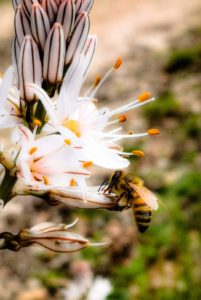
[Photo by Stefano Mancinelli]
We also know how harmful and dangerous pollution and, above all, the indiscriminate use of synthetic pesticides are for these hard-working insects, which play a crucial biological role as well as providing us all with a unique and complete food product: honey, a natural product made by bees from flower nectar, which is collected and then processed. The wide variety of honeys produced by these insects depends on the great variety of flowers they visit and the diversity of the nectar and honeydew they collect. Honey is a unique food rich in simple sugars, organic acids, proteins, amino acids, vitamins, minerals, and volatile substances. Its remarkable properties are antioxidant, antimicrobial, and anti-inflammatory, not to mention other products secreted by bees such as royal jelly, propolis, and the pollen collected from flowers.
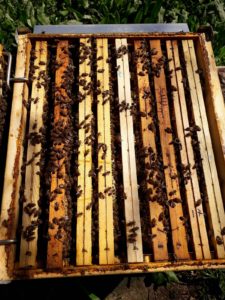
[Photo by Luca Pasquarelli]
Bees are not dangerous insects for humans, but we need to be careful not to harm them and risk being accidentally stung in self-defense while they are busy collecting nectar and moving from one plant to another. In short, bees are true allies of the beauty of our parks, gardens, vegetable gardens, and plant biodiversity. It is up to us to take care of the natural environment and ensure that they have the conditions to continue to play an irreplaceable role in the ecosystem.
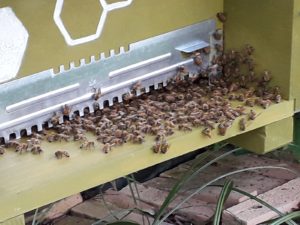
[Photo by Luca Pasquarelli]
