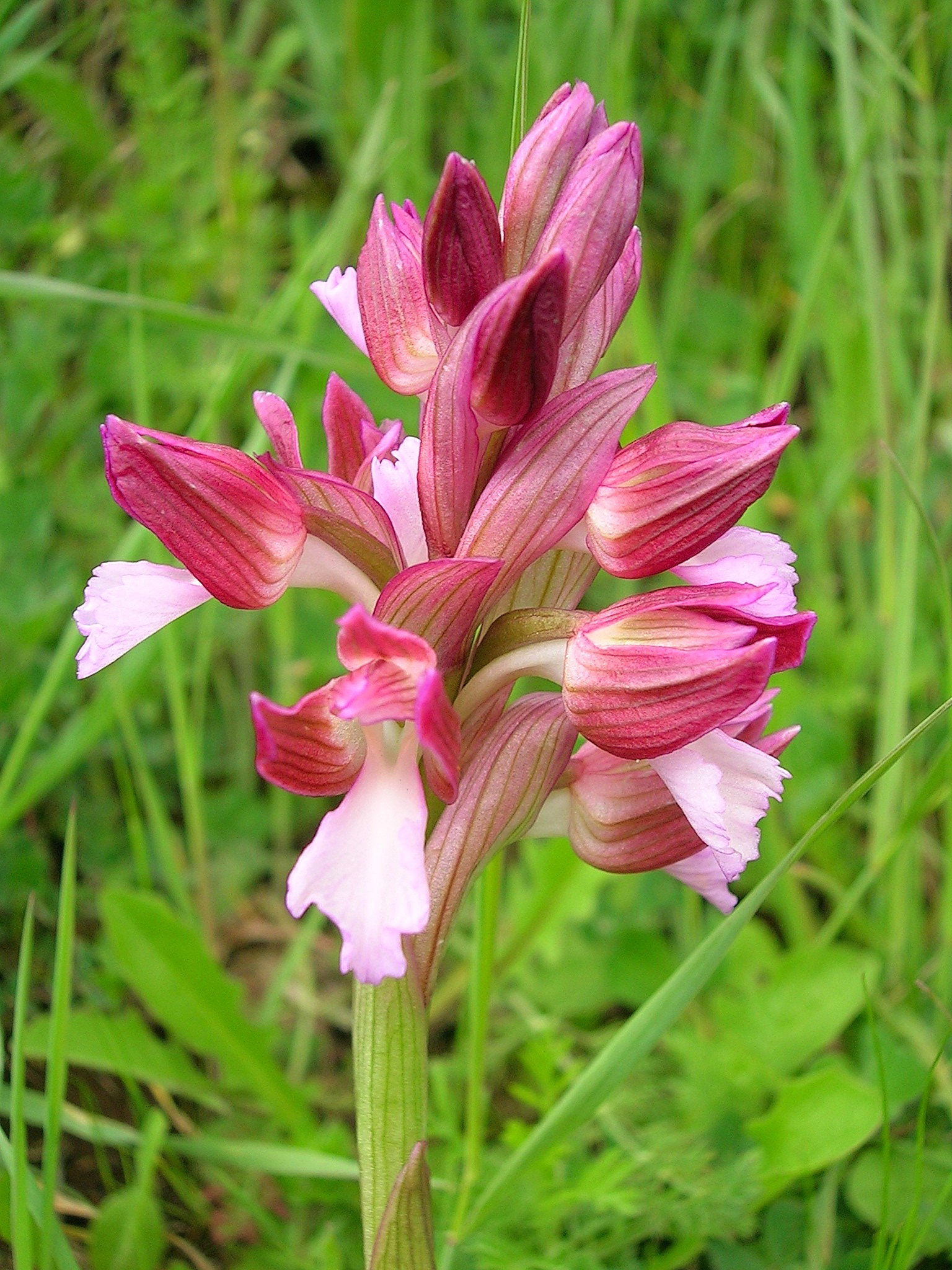
Italian name: Butterfly orchid
Synonyms: Anacamptis papilionacea
Orchis papilionacea (Butterfly Orchid). This plant grows to a height of 15–40 cm and has a sturdy, rigid, angular stem that is reddish at the top.
The basal leaves are arranged in a rosette, are green-glaucous in colour and linear-lanceolate in shape.
The specific name derives from papilio = butterfly, due to the shape of the labellum, which resembles the wings of a butterfly. Pollination is carried out by small wasps of the genus Eucera tuberculata, whose males, attracted by a visual deception (in reality, this flower has no nectar), leave their pheromones on the labellum in order to attract females of the same species.
Description of the Butterfly Orchid
The leaves along the stem wrap around it and decrease in size towards the top. The spike inflorescence is more or less dense (6-10 flowers), with membranous bracts longer than the ovary, purple in colour with brown veins. The flowers are very showy with purple-red petals and sepals characterised by prominent dark streaks, connivent in a rather loose helmet. The labellum is undivided, usually crossed by thin darker streaks, and is narrow at the base and then widens like a fan at the apex; the edge has raised and wavy margins. The spur is conical, slightly descending and with purple hues.
Where to find the butterfly orchid
It is found in the wild in uncultivated meadows, sparse scrubland and light woods at altitudes ranging from 0 to 1,600 metres (more frequently between 0 and 600 metres). In Italy, it is present in all regions except Trentino Alto Adige and Friuli Venezia Giulia.
The flowering period is from March to June.