Class:Mammals(Mammalia)
Order:Carnivores(Carnivora)
Family:Felids(Felidae)
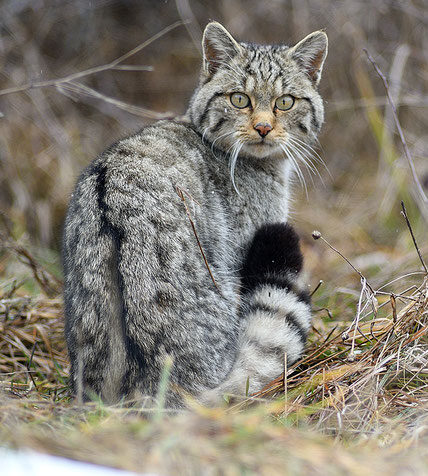
The wildcat (Felis silvestris silvestris, Schreber 1777) is an animal with a robust and very agile body, a short, rounded head, strong, long legs, especially the hind legs, and a tail that is truncated at the end. It measures about 1.20 metres in length, including the tail, and weighs 3–8 kg. Its coat is thick and soft, grey or fawn in colour, lighter on the belly, with black transverse bands; the tail is about 35 cm long, uniformly thick, with rings and a black tip. Sexual dimorphism mainly concerns body size and weight, which are significantly greater in males. It has excellent eyesight even in poor light conditions, a very good sense of smell and excellent hearing. It has straight ears that are broad at the base and yellow eyes. Its canines and feral teeth are particularly well developed, suitable for tearing prey apart.
Habits and Diet
It is a shy and solitary animal and even when living in pairs it tends to maintain its individuality. Its life expectancy is around 13-14 years. It has crepuscular-nocturnal arboreal habits and during the day it remains hidden in tree cavities, in dens abandoned by other animals in rock crevices. Instead of moving on the ground, it often prefers to jump from branch to branch, from where it can spot its prey thanks to its excellent eyesight, while remaining protected from the animals that prey on it, namely wolves. Males defend their territory by depositing faeces and releasing scent marks by spraying urine. The wildcat is linked to forest habitats, particularly deciduous woods, mainly because of the protection offered by the vegetation. It is rarely found in high altitude areas, probably because snow limits its hunting and movement. It avoids places frequented by humans. It is an exclusively carnivorous animal and its favourite prey are rodents and small mammals, but it is also an opportunistic predator that, when necessary, will not disdain amphibians, insects and birds that it finds in nests.
Reproduction
It reproduces once a year. During the mating season, which runs from January to March, males intensify their marking of the surrounding environment in order to attract females in heat and warn off potential rivals. During this period, their characteristic mating calls can be heard, which are among the few vocalisations made by this animal. Gestation lasts about 66 days and between March and June, 3 or 4 kittens are born. The kittens are born in hidden, inaccessible places, wrapped in the placenta, blind and totally dependent on their mother. At birth, they weigh 75-150 g and have a spotted coat. Only later, as they grow, do the spots merge to form stripes. After the third month, they begin to become independent.
Relationship with humans
The wildcat in Italy has been classified as a “Near Threatened” (NT) species by the IUCN (International Union for Conservation of Nature), and hybridisation with domestic cats is a threat to the conservation of the wildcat.