Class:Aves
Order:Falconiformes
Family:Falconidae
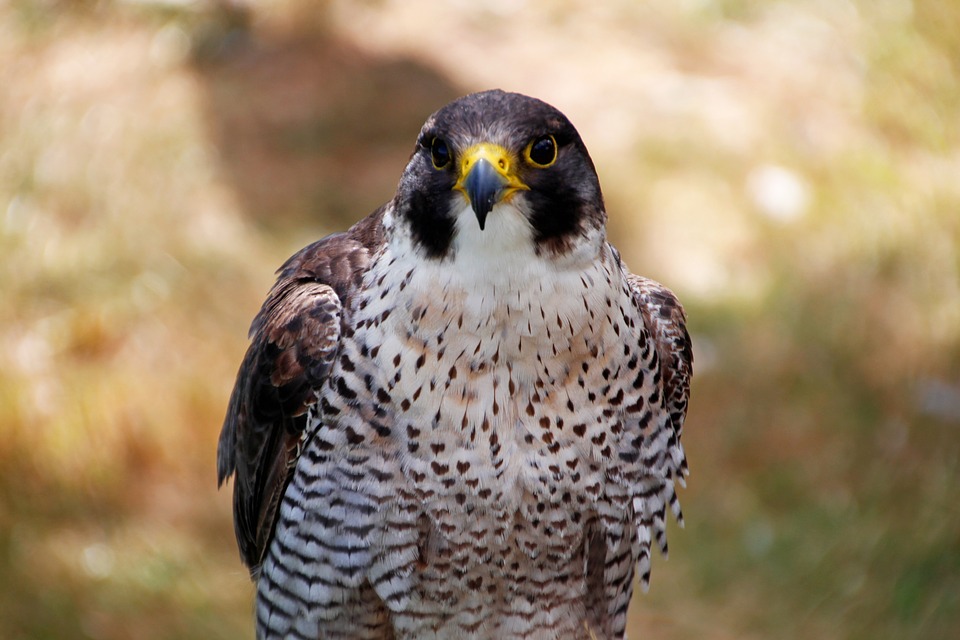
The peregrine falcon (Falco peregrinus, Tunstall, 1771) is a bird of prey belonging to the Falconidae family, found almost everywhere in the world: (Europe, Asia, Africa, North America, South America and Oceania). In its scientific name, the word “peregrinus” (used to indicate the species) refers to the dark colouring of the feathers on its head, which resemble a black hood similar to those worn by pilgrims. The peregrinus peregrinus falcon, the subspecies in question, described by Tunstall in 1771, breeds in the temperate part of Eurasia between the tundra in the north and the Pyrenees, the Mediterranean Sea and the Alpine belt. In Europe, it is essentially sedentary, while it is migratory in Scandinavia and Asia. Males weigh 580-750 g, while females weigh 925-1030 g. The subspecies includes brevirostris, germanicus, rhenanus, and riphaeus. It is considered a superpredator.
The peregrine falcon is known for its high speed. It is believed to reach a maximum speed of 385 km/h in a dive, making it the fastest living animal. It has a length of between 35 and 58 cm and a wingspan of 80–120 cm. Males and females have similar plumage but, like many other birds of prey, they are characterised by marked sexual dimorphism, with females being about 30% larger than males.
The back and pointed wings of adults are usually bluish black to slate grey in colour, with some streaks characteristic of the subspecies. The tips of the wings are black, while the underside is streaked with thin dark brown or black bands. The tail, which is the same colour as the back but with distinct streaks, is long, thin and rounded at the end with a black tip and a white band at each end. The black head contrasts with the light sides of the neck and white throat. The “wax” of the beak and legs are yellow, while the beak and claws are black. The tip of the beak has a notch, the result of a biological adaptation that allows the hawk to kill its prey by breaking its cervical vertebrae. Immature juveniles are characterised by a browner colour with streaked rather than barred underparts; the “wax” and orbital ring are pale blue.
The peregrine falcon is easily distinguishable from the common buzzard (Buteo buteo) due to its compact body and more agile silhouette. Its wings are narrow and pointed, rather than broad and fringed at the tips like those of the buzzard. Its fast, vigorous wing beats are also noteworthy, whereas the buzzard’s wing beats tend to be slower. It is more difficult to distinguish it from the kestrel, which is smaller and less bulky and has a longer tail, but is otherwise similar. However, unlike the kestrel, the peregrine never performs the “holy spirit”, a hunting technique useful for catching insects and rodents, which consists of hovering motionless in the air thanks to small wing movements.
It is a highly skilled hunter capable of attacking prey even in mid-air. Contrary to popular belief, it is not capable of flying horizontally at high speeds.
Feeding
The peregrine falcon’s hunting strategy consists of positioning itself in a dominant position relative to its prey. This can be achieved in one of the following ways: finding a perch in an elevated position, for example on a mountain; gaining altitude, almost always by exploiting thermal currents, and then patrolling favourable terrain from above; or, more rarely, attacking prey from below, forcing it to flee to very high altitudes and then moving above it, finally pursuing it in a dive.
The actual capture of the prey takes place with the so-called “stabbing”, a blow delivered with both claws, which serves to stun, unbalance or injure the prey, which falls to the ground, where it is killed with the powerful beak. More rarely, the falcon grabs its prey. The peregrine falcon never hunts on the ground.
In Italy, it hunts mainly in open spaces and can therefore be observed in almost all biotopes, but it prefers open spaces and lake basins with an abundance of birds.
Social behaviour and relations with humans
Peacock hawks remain together for life and mate again if one of the partners dies. The incubation period lasts from 32 to 37 days, depending on the latitude and humidity of the area chosen for nesting. The clutch usually consists of 3-4 eggs.
They reach an average age of 17 years in the wild, but cases have been observed in captivity where individuals have exceeded the age of 20.
For many centuries in Europe, egg collectors, gamekeepers and carrier pigeon breeders have taken a constant, and sometimes heavy, toll on the eggs, young and adults of the peregrine falcon, but the overall population has resisted, despite high juvenile mortality[36]. Around 1955, many populations experienced a significant decline: dead specimens were frequently observed, but above all, eggs were found broken in abandoned nests. A veritable collapse began, leading to the complete collapse of some populations. In central and northern Europe, they disappeared almost entirely, and in England, the population fell from around 700 pairs in 1955 (S. Cramp, 1980) to 68 in 1962 (D. Ratcliffe 1980). However, almost all the populations in the Mediterranean survived (S. Cramp 1980).
Many researchers began to suspect that the cause could be pollution from chlorinated insecticides (DDT and, in particular, DDE). But it was Ratcliffe (studying eggs from museum collections) who demonstrated that, between 1945 and 1947, coinciding with the widespread introduction of these products in agriculture, the shells of peregrine falcon eggs had suddenly begun to thin. Biologists, in particular D. S. Miller, were subsequently able to demonstrate that the insecticides in question cause an enzymatic alteration of carbonic anhydrase and calcium ATPase, which transport calcium from the female’s bloodstream to the egg shell as it forms. The same alterations, and the same catastrophe, were found in other falconiforms, particularly those that feed mainly on birds, such as the sparrowhawk. The mode of poisoning was identified in the food chain: insect-insectivorous bird-hawk. The discrepancy between the years of the first massive poisonings and those of the actual collapse of the populations can be explained by the survival of adults, who are more resistant to poisoning, whose failure to reproduce led to effects that were only visible a few years later.
Following the ban on DDT, the strict protection of nesting sites from the removal of eggs and nestlings for the revival of falconry, and significant reintroduction efforts, populations have gradually and almost completely recovered since the 1970s.