With the Circus Maximus behind us, the Palatine on our left and the Colosseum a few hundred of steps starts our Way.
Here stood Porta Capena and from this gate, which was located in front of the curved side of the Circus Maximus, both the Via Appia and the Via Latina began, which then separated into the area of the present Piazzale Numa Pompilio.
The Porta Capena belonged to the oldest walls of Rome, called “Serviane” because the tradition attributed the construction to the sixth king of Rome Servio Tullio, of the mid-sixth century. B.C.
When the emperor Aureliano built the new city walls, the stretch of the Appian Way between Porta Capena and Porta S. Sebastiano became the urban stretch of the street, because in ancient times it was part of the city.
It is the largest entertainment venue of antiquity and one of the largest of all time (600 m long and 140 m wide), linked by legend to the very origins of the city: here, in fact, the rats of Sabina marked one of the first important events in the city of Rome.
Inaugurated in 216 during the reign of Marcus Aurelius Antoninus Bassianus, known as Caracalla, they were famous in ancient times as one of the seven wonders of Rome for the richness of their decorations and works of art, and are still preserved today in some places to a height of over thirty meters.
On the Appian Way, in the Aurelian Walls, a gate was opened, the southernmost in the city, whose original name was Porta Appia; from the Middle Ages onwards, the name Porta S. Sebastiano prevailed, as it led to the famous catacombs of that martyr. The monument can be visited and houses the Museum of the Walls.
One of the few industrial plants that have survived in the city of Rome, it is a unique structure, exceptional for its strategic position near the Aurelian Walls. Bathed along its entire length by the Almone River, it ideally connects the Appia Antica to Via Cristoforo Colombo.
At the intersection of Via Appia Antica and Via Ardeatina, on the left-hand side, there is a small church known as Domine Quo Vadis? The name is linked to the legendary episode of the appearance of Jesus as a traveler to the apostle Peter, who was fleeing Rome because of Nero’s persecutions. When Peter asked him, “Domine, quo vadis?” (Where are you going, Lord?), the answer was, “I am going to be crucified again”; upon hearing these words, the apostle turned back to face martyrdom.
At the intersection of Via Appia and Via Ardeatina stands the tomb that, according to some hypotheses, Titus Flavius Abascanto, an influential freedman of Emperor Domitian, had built for his wife Priscilla, who died prematurely. Her funeral is described by the poet Statius (Silvae, V, 1).
Artificially arranged on the side of the hill is the monument also known as the “Grotto of Egeria”: an imposing rectangular nymphaeum, with a large niche at the back and three smaller niches on the sides, where statues of river gods were placed, from which mineral water flowed from a spring located under Via Appia Pignatelli. today, the rear niche contains a semi-recessed male statue from which water flows, possibly representing the god Almone.
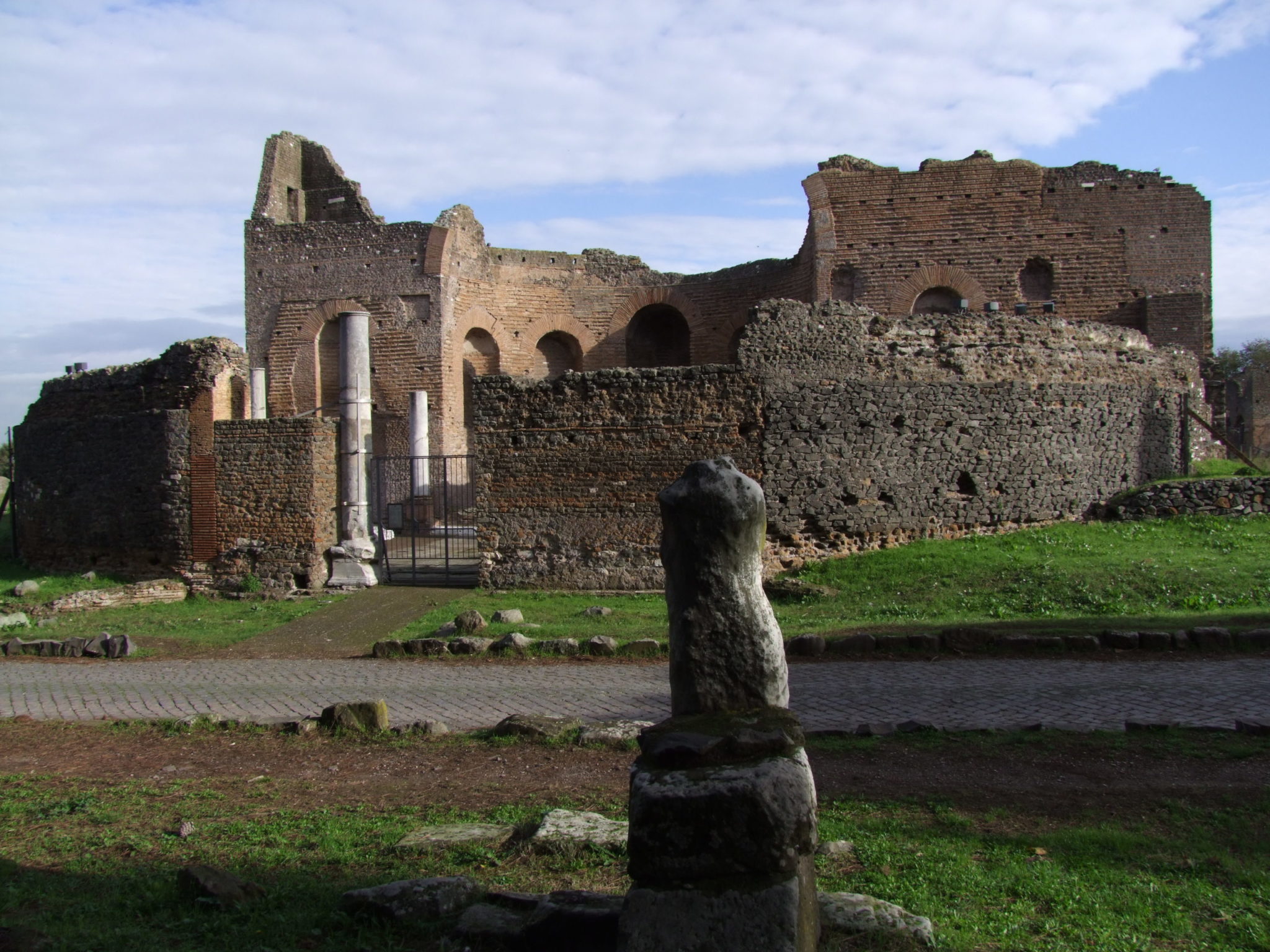
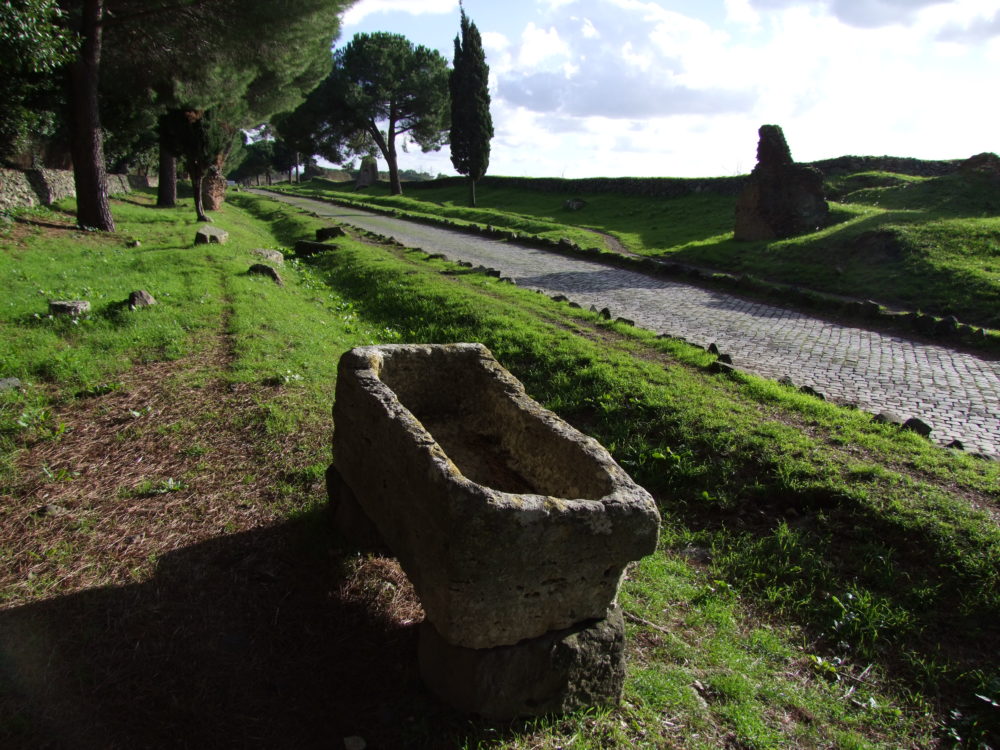
The section between Cecilia Metella and Casal Rotondo is the most monumental part of the road, characterized on both sides by an uninterrupted succession of tombs of various types, built using different construction techniques, from the Republican era to the late Imperial period. This section, up to the fifth mile, also includes the sumptuous villa of the Quintili family from the Imperial period. From the area of the Mausoleum of Cecilia Metella to the ninth mile, Luigi Canina carried out conservation and restoration work, adding a frame of pine and cypress trees that still characterizes the landscape of the Appian Way today. Subsequent restorations have recovered and restored large sections of the ancient road paving and the ancient crepidini (sidewalks), with the aim of restoring the Via Appia to the configuration of an “open-air museum” conceived by Canina.